ACPA Awards
Association Awards, Overall Entity Awards & Individual Entity Awards
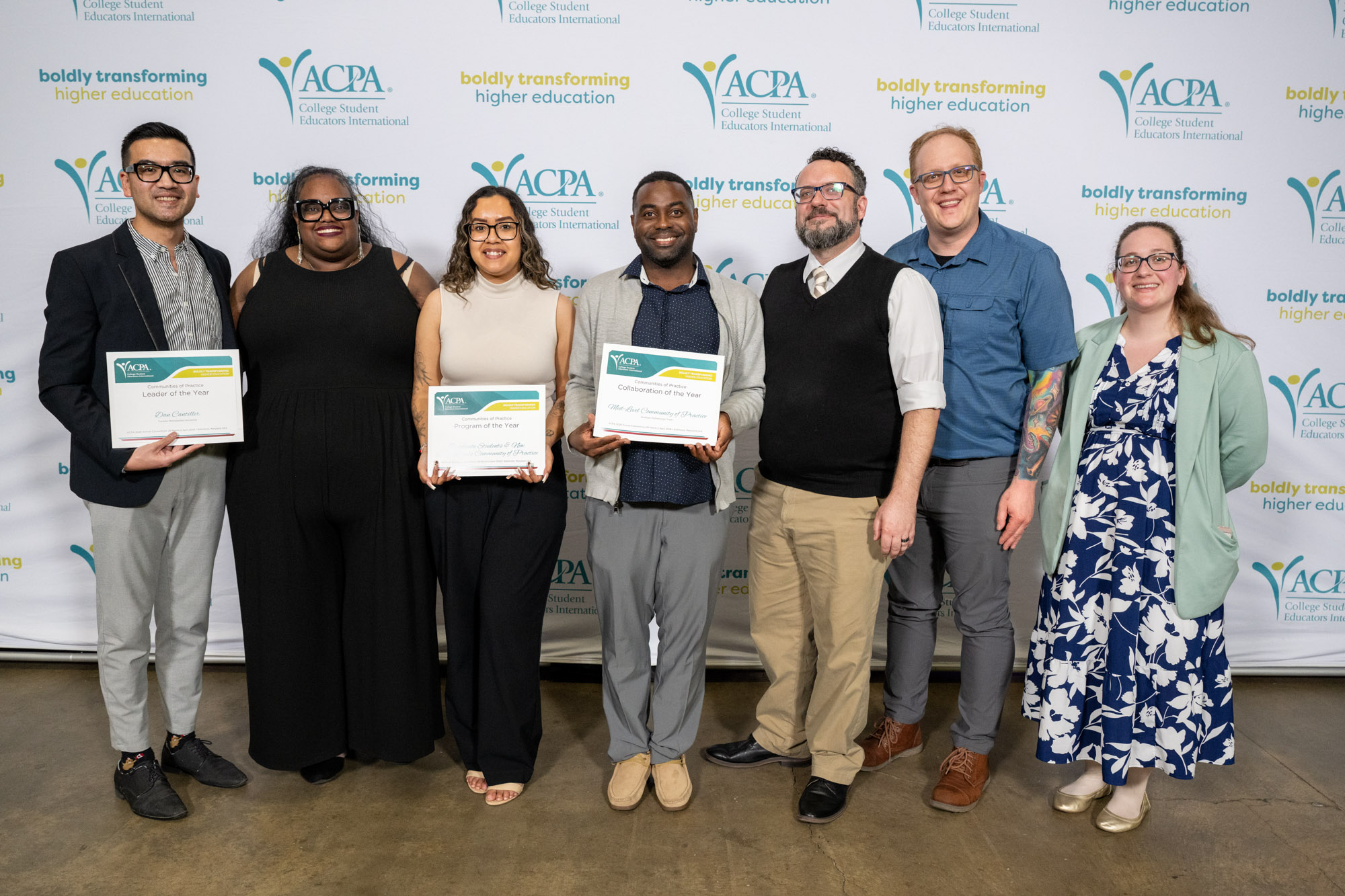
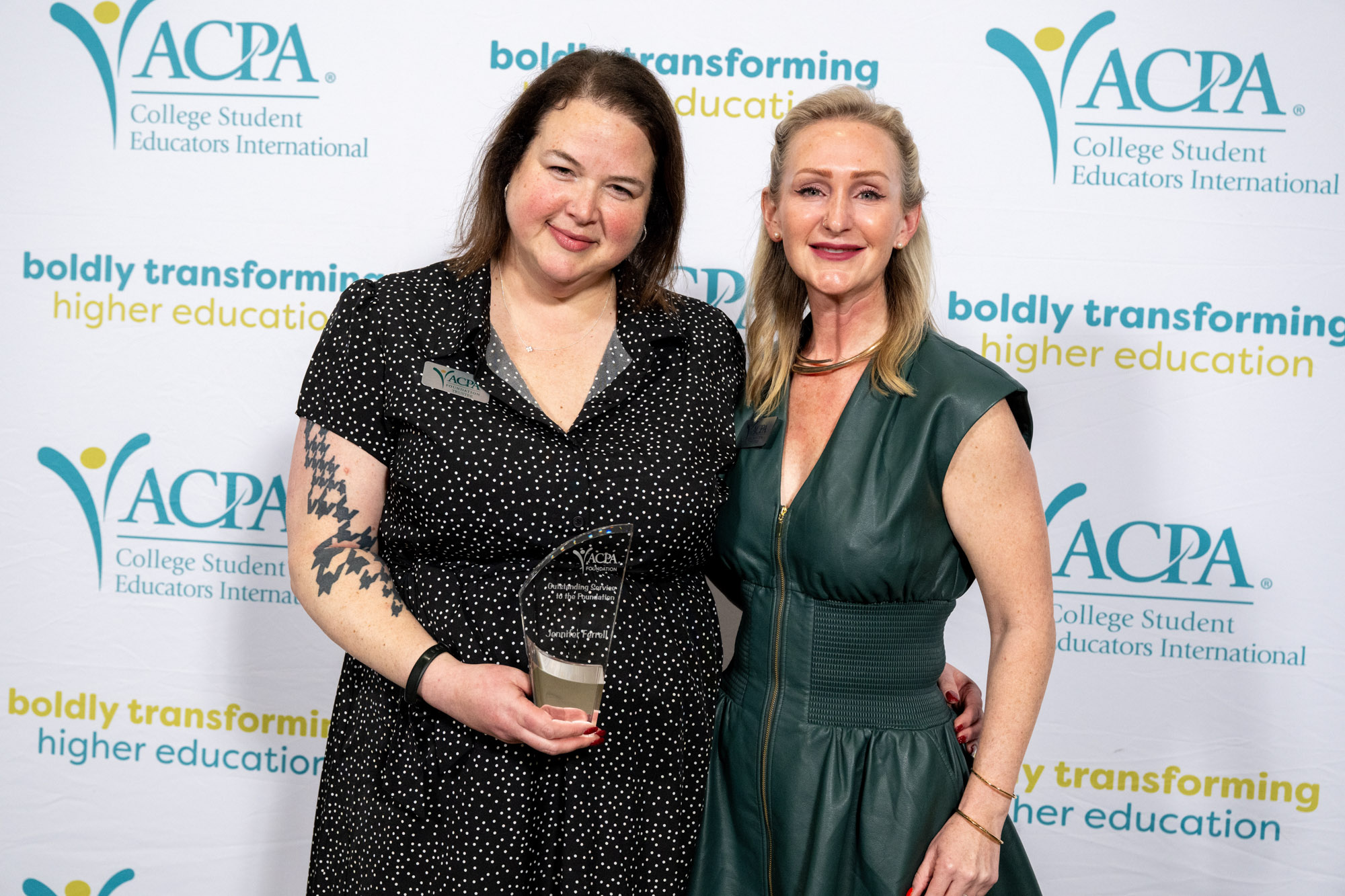
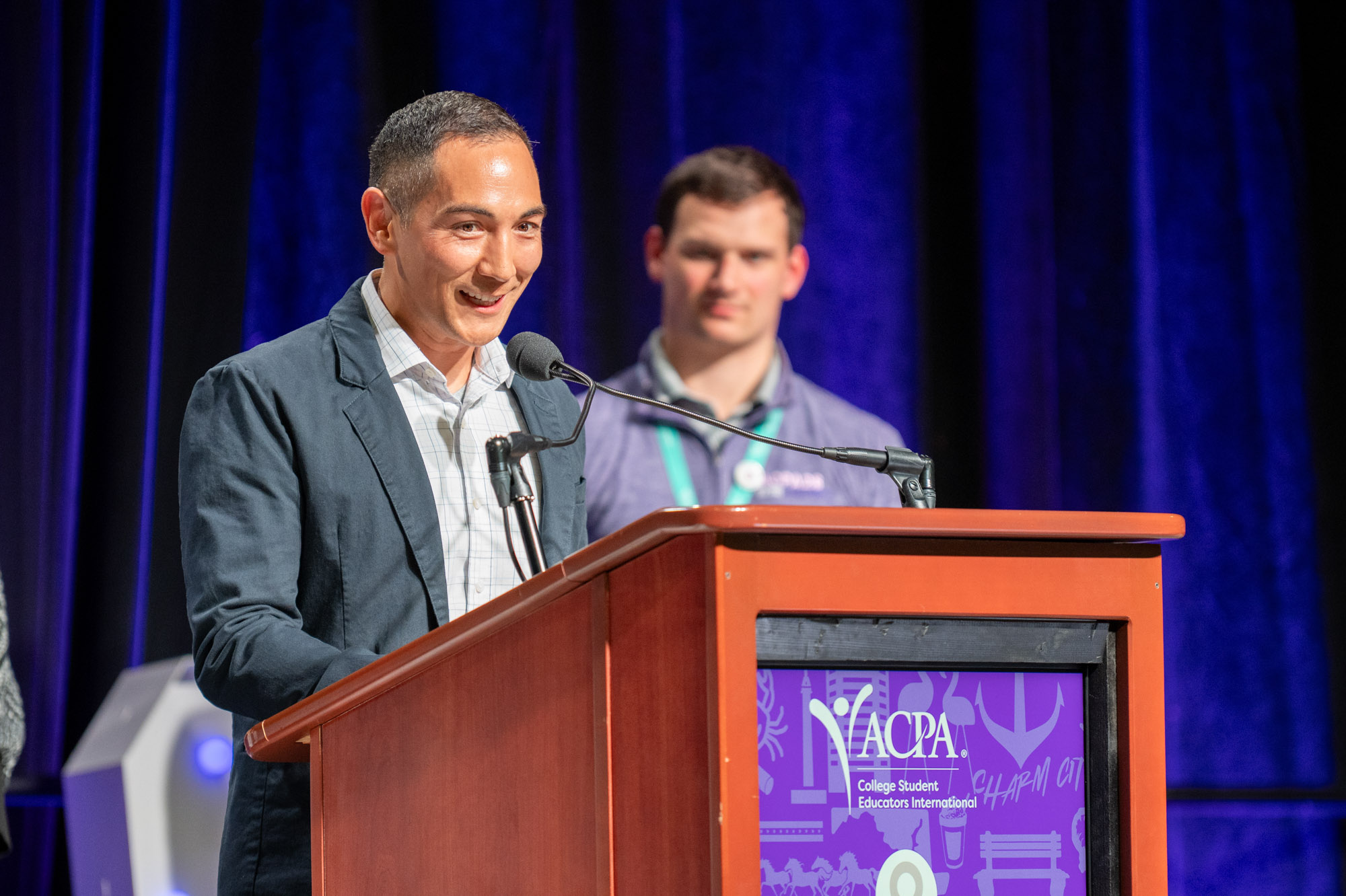
Awards are broken up into two parts: Association-Wide Awards are the highest honors and recognition ACPA provides the profession; Entity Awards highlight accomplishments of individuals, programs, and entities (Chapters, Divisions, Coalitions, Networks, Commissions, and Communities of Practice). They are an opportunity to highlight best practices and scholarship that benefit students, recognize members and highlight accomplishments. We encourage all members to nominate at least one deserving mentor, peer, colleague, student, or supervisee for one of these awards.
If you have any questions about the awards information or awards program, please contact recognize@acpa.nche.edu (unless another contact is noted).
We NEED AWARD REVIEWERS!
The ACPA Awards and Recognition Council (ARC) is seeking active ACPA members who are willing to serve as ACPA Association-Wide Award reviewers. Members selected as reviewers will receive self-guided training on the 2027 awards review process with the option to attend Zoom Office Hours with ARC for any questions in October. Once the Assocation-Wide Award deadline has passed on October 30th, award reviewers will receive their assignments, materials, etc. and have the opportunity to self-disclose any conflicts of interest so assignments can be adjusted as needed. Reviewers should expect to commit approximately 3 hours per week over a 3 week period in November to review materials, submit rubrics, and share feedback on nominations. This time commitment will depend upon the number of reviewers and volume of applications, but it is ARC’s goal not to exceed this expectation.
NOMINATION DEADLINES:
30 October 2026:
- Association-Wide Awards
- Overall Entity Awards
- Individual Community of Practice Awards
13 November 2026:
- Individual Commission Awards
- Other Individual Entity Award deadlines vary
Association-Wide Awards
The 13 Association Awards below represent the highest honors and recognition at the Association-level, including the recognition of scholarship, service, collaboration, contributions, lifetime achievement, innovation, and inclusion. The nomination period for the 2026-2027 cycle is 10 August-30 October 2026 at 11:59pm ET. ACPA encourages members to nominate yourself or a colleague for one of these prestigious honors!
Click on the Award name to learn more about the requirements, expectations and nomination instructions for each.
Your Title Goes Here
Lifetime Achievement Award
Award Criteria
- Evidence of significant involvement and service to the field
- Evidence of significant scholarly productivity and/or exemplary leadership in the field
- Evidence of sustained contribution to the field
Required Documentation
- A letter of nomination that articulates how the individual meets the criteria for the award and includes the nominee’s name, email address, and telephone number
- A minimum of two to three supporting letters from other leaders in the field
- The nominee’s resume or curriculum vitae
Contribution to Knowledge Award
Award Criteria
- Evidence of a body of work that significantly impacts and advances the field
- Evidence of sustained reputation as a thought leader and scholar in the field
- Evidence of a scholarly record that is recognized and used by other scholars and scholar-practitioners
- Demonstrated commitment to ACPA
Required Documentation
- A letter of nomination that articulates how the individual meets the criteria for the award and includes the nominee’s name, email address, and telephone number
- A minimum of two to three supporting letters from other scholars and leaders in the field
- The nominee’s resume or curriculum vitae
Contribution to Higher Education Award
Required Documentation
- A letter of nomination that articulates how the individual/organization meets the criteria for the award and includes the nominee’s name, email address, and telephone number
- A minimum of three supporting letters from leaders addressing how the nominee has made significant contributions to higher education
- The nominee’s resume or curriculum vitae (if an individual)
Esther Lloyd-Jones Professional Service Award
Award Criteria
- Minimum of 15 years as a scholar or practitioner in student affairs within an institution of higher education
- Evidence of making a significant contribution(s) to the co-curricular student experience, their campus, and/or their colleagues
- They are well-versed in the literature and have demonstrated the application of theory to practice in their work. (This could include student affairs, developmental theory, environmental and cultural literature, and research.)
- Demonstrated commitment to ACPA
Required Documentation
- A letter of nomination that articulates how the individual meets the criteria for the award and includes the nominee’s name, email address, and telephone number
- The nominee’s resume
- Two supporting letters from other leaders in the field
Marylu McEwen Dissertation of the Year
presented by the ACPA Foundation
This award aims to recognize a completed dissertation that demonstrates scholarly excellence and makes a substantial contribution to knowledge in the general field of student affairs/student services. The dissertation may be in any scholarly tradition or methodology and focus on any topic in the field.
The Dissertation of the Year Award is named in honor of Dr. Marylu McEwen, Professor Emerita in the Student Affairs concentration with the Department of Counseling, Higher Education, and Special Education at the University of Maryland, College Park. Additional information on Dr. McEwen can be found here.
The ACPA Foundation funds the financial award through an endowment started by a generous gift in honor of Marylu McEwen.
Eligibility
- Eligible dissertations must have met all requirements of the applicant’s institution and have been signed by the applicant’s dissertation committee between 1 April 2025 and 1 August 2026.
- A dissertation may only be nominated once. Dissertations previously nominated will not be reconsidered.
- The faculty nominator must be the dissertation committee chair or a member of the dissertation committee and an ACPA member at the time of the nomination.
- The nominee must be a member of ACPA prior to receipt of the award.
Award
- One recipient will be selected annually. Additional nominees may be cited for excellence.
- The recipient will receive a plaque, complimentary annual convention registration for the recipient and their advisor, and a cash award of $1,000.
- The recipient will also participate in a one-on-one phone call/virtual chat with Dr. McEwen.
- The recipient will have a reserved slot to present the dissertation results in a session during ACPA27.
Selection Process
- The application package should be submitted using this Online Application.
- Applicants will upload all required documents when applying.
- The applicant must submit a 15 double-spaced page abstract of the dissertation (inclusive of any tables and/or figures). The abstract should include the following: (1) full dissertation title; (2) statement of the study’s purpose; (3) research questions, if applicable; (4) significance of the study; (5) theoretical or conceptual underpinnings, if applicable; (6) methods – research design/approach, sampling, data collection procedures or data sources used, and data analysis; (7) summary of key findings; and (8) implications for practice, policy, and/or future research. The abstract should contain no identifying information that reveals the author, committee members, or institution. Additionally, up to three single-spaced pages of references in APA format can accompany the abstract and will not be included in the 15-page limit. Please submit the abstract as a PDF and use the first few words of the Running Head as the title. Please use the same file name for naming all files, including the abstract and certification form. This standardized naming convention is essential to the efficient processing of the submission.
- The selection process is masked. The identities of the applicants and the dissertation committee members are masked from the reviewers. The committee chair will ensure that dissertations from the reviewers’ institutions are not reviewing nominees’ materials. Committee members will recuse themselves if they know the nominee, committee members, or the dissertation.
- The applicant’s dissertation advisor must sign a certificate statement (PDF) verifying that the applicant has met the institution’s degree requirements and has been approved by the applicant’s dissertation committee. The applicant will submit this form with the application.
- The recipient will be selected and notified no later than January 2026. The committee’s decisions are final.
- The deadline for submissions is 30 October 2026.
If you have any questions, please contact Dr. Kaity Prieto, Kaitlin.PrietoGodoy@usm.edu, or Dr. Ricardo Montelongo, rxm059@shsu.edu.
Nancy J. Evans Voices of Inclusion Award
The Voices of Inclusion award was established in 2002 by then-ACPA President Nancy Evans. It was first awarded at the 2002 Convention in Long Beach, California, which had a theme of “Voices of Wisdom: Stories of Inclusion, Practice, and Scholarship”. Merriam-Webster defines “voice” as a “wish, choice, or opinion openly or formally expressed” or a “right of expression; also: influential power”. In many of our cultures, one’s “voice” is where people find their strength, their truth, and their connection to others. Our voices are the ways we share, express, and advocate.
The Voices of Inclusion Award recognizes members who use their voice to make their campuses, our Association, and the field a more equitable, inclusive, and just place. Since we acknowledge that all forms of oppression are linked, it is important to consider how we empower, engage, and advocate for people from multiple marginalized populations when discussing the Voices of Inclusion. We understand that these efforts come in many forms: individuals, groups, communities, and activities. This award seeks to recognize voices of inclusion, no matter the form.
This award is presented annually at the ACPA Annual Convention. Two recipients are given this award each year.
Nomination Instructions
Each nomination should include:
- An essay (minimum of 1200 words) that explains how the nominee exemplifies the purpose of the Voices of Inclusion Award and addresses the ways that others have felt the sustained impact of that work. This essay should provide specific examples so that it is clear to the selection committee how the nominee effectively supported multiple marginalized populations. The essay’s author will serve as the primary nominator for this award.
- A statement of the nominee’s history. For individuals, this might be a resume or CV. For groups, communities, and events, this might be a document explaining the group’s purpose and history, including its founding, current status, and dates in between.
- A letter of support from a source separate from the primary author of the essay.
- While not required, nominators can choose to submit additional documentation. This might include statements of support from students or other community members, artifacts that demonstrate work or impact, metrics and assessments, event programs or agendas, or other relevant documents at the nominator’s discretion.
Harold E. Cheatham Innovative Practice Award
Award Criteria
- Minimum of 8 years as a practitioner in student affairs
- Evidence of making a significant contribution(s) to the co-curricular student experience, their campus
- Evidence of implementing innovative practices
- Demonstrated commitment to ACPA
Required Documentation
- A letter of nomination that articulates how the individual meets the criteria for the award and includes the nominee’s name, email address, and telephone number
- The nominee’s resume
- Two supporting letters from the department and campus leadership
Your Title Goes Here
Collaborative Excellence Award
Award Criteria
- Evidence of exemplary partnership or collaboration for at least 2 years
- Evidence that the program fosters student learning and has contributed positively to the university
- Documented assessment of the program learning outcomes and results
- Demonstrated commitment to ACPA
Required Documentation
- A brief abstract of the program
- A nomination letter that articulates (a) The program’s benefits to students; (b) How the collaborative relationship (including the expression of values/ethics, roles/responsibilities, communication, and teams/teamwork) is critical to the achievement of the program’s goals and outcomes; (c) Evidence that demonstrates excellence and effectiveness of the program; and, (d) the name, email address, and telephone number for the collaborative program’s point person
- Copies of marketing materials, articles, or other publications related to the program, if appropriate
- Two supporting letters from leaders in the field or a letter from the college/university president expressing why the collaborative program is so critically important to the institution in place of two supporting letters
- Acknowledgement by senior leaders in the collaborating departments/institutions offering their support for the partnership and program (these may serve in the place of the two supporting letters or they may be simple brief statements of support in addition to the two letters)
Annuit Coeptis: Emerging Professional
This award is intended to be a generative and cross-generational experience. The dinner models the importance of being both teachers and learners. It invites awardees to practice the synergy that can be created when we come together with cross-generational wisdom.
Criteria for Emerging Professionals
- No more than five years of full-time professional experience since completion of a master’s degree.
- Evidence of the potential for significant contribution to the field of student affairs in at least one of the following areas: (a) administrative service or teaching; (b) presentations (to include conference presentations) of innovative practice(s) or scholarship; (c) professional association service; or (d) leadership.
- Recipients must register and attend the 2027 ACPA Annual Convention in Toronto and attend both the 2027 Annuit Coeptis Reception and Dinner. Both are tentatively slated for the evening of Monday, 15 March 2027 (more details will be shared with award recipients). Please note that this may briefly overlap with the 2027 Diamond Honoree Reception.
To nominate a colleague or yourself for the Emerging Professional Award, please submit the nominee’s current resume and at least one nomination letter. All nomination letters should be combined and submitted as a single PDF file. Nomination materials must be received no later than 30 October 2026 via the form below.
If you have any questions, please contact Dr. Ellen Broido, ebroido@bgsu.edu.
Annuit Coeptis: Senior Professional
This award is intended to be a generative and cross-generational experience. The dinner models the importance of being both teachers and learners. It invites awardees to practice the synergy that can be created when we come together with cross-generational wisdom.
Award Criteria for Senior Professionals
- Evidence of extensive and sustained contributions to the field of student affairs in the areas of (a) administrative service or teaching, (b) research and publication, (c) professional association service, and (d) demonstrated leadership.
- Evidence of Phil Tripp’s commitment to mentoring and encouraging early career student affairs professionals.Recipients must register and attend the 2027 ACPA Annual Convention in Toronto and attend both the 2027 Annuit Coeptis Reception and Dinner. Both are tentatively slated for the evening of Monday, 15 March 2027 (more details will be shared with award recipients). Please note that this may briefly overlap with the 2027 Diamond Honoree Reception.
- To nominate a colleague or yourself for the Emerging Professional level, please submit the nominee’s current resume and at least one nomination letter. All nomination letters should be combined and submitted as a single PDF file. Nomination materials must be received no later than 30 October 2026 via the form below.
To nominate a colleague for the Senior Professional Award, please submit the nominee’s resume and a letter explaining how the person meets the criteria listed below; up to two additional letters of support are encouraged. All nomination letters should be combined and submitted as a single .PDF file. Nomination materials must be received no later than 30 October 2026 via the form below.
Please note that past recipients of the Emerging Professional Award are eligible for the Senior Professional Award later in their careers.
If you have any questions, please contact Dr. Ellen Broido, ebroido@bgsu.edu.
Senior Scholars Program 2027-2032
The mission of the ACPA Senior Scholars is three-fold:
1) To foster the development of promising early-career scholars through the Emerging Scholars program
2) To engage in critical conversations centering the Strategic Imperative for Racial Justice and Decolonization in scholarship and practice
3) To promote the advancement of student affairs knowledge through various mechanisms for practitioners, educators, and scholars in the association and in the larger professional community
Senior Scholars are advanced members within the profession and field (e.g., advanced associate professors, full professors, and/or senior student affairs officers) who have made exemplary and
sustained contributions to ACPA’s mission transforming higher education by creating and sharing influential scholarship, shaping critically reflective practice, and advocating for equitable and inclusive learning environments. A maximum of 12 Senior Scholars can hold active membership.
Senior Scholars serve a five-year term and must maintain membership in ACPA throughout their term. The term begins at the end of the convention following the appointment as Senior Scholar.
Expectations of Senior Scholars
- Attend at least four ACPA national conventions during the five-year term (does NOT include the convention in which you are awarded and named a Senior Scholar)
- Actively participate in the work of the Senior Scholars:
- Coordinate ACPA Senior and Emerging Scholars sessions at the ACPA Annual Convention
- Direct the Emerging Scholar and Senior Scholar selection and onboarding processes
- Serve on committees or liaison with relevant groups (e.g., Publications
Committee, Awards and Recognition Council, Dissertation of the Year Selection Committee, SSAO Advisory Board) of the Association - Lead efforts to support ACPA’s mission, vision, and values and the Strategic Imperative for Racial Justice and Decolonization
- Administer the Senior Scholar Grant Program
- Advance the scholarship agenda of ACPA
Expectations of Diplomates
ACPA Senior Scholar Diplomates are encouraged to continue to serve the association and to be involved with Senior Scholar activities as they are interested and able.
Diplomate status is conferred upon Senior Scholars who have fulfilled Scholar expectations and participated in at least four of five (2027, 2028, 2029, 2030, 2031) ACPA national convention meetings during the Senior Scholar term.
Orientation and End of Service
New Senior Scholars will be recognized a the ACPA Awards Ceremony at the Annual Convention following their selection. Senior Scholars complete their term of service at the close of their 5th Annual Convention.
ACPA Senior Scholar Diplomate status is conferred upon Senior Scholars who have fulfilled Scholar expectations. Scholars achieving Diplomate status will be recognized at the ACPA Awards Ceremony at their 5th Annual Convention.
Application Process
To apply for ACPA Senior Scholars, submit a single PDF file with the following materials: (a) current CV, and (b) cover letter with responses to questions below (no more than 250 words per question):
- How can you help the Senior Scholars advance our statement of action?
- How do your scholarly interests and trajectory align with those found in ACPA’s A Bold Vision Forward: A Framework for the Strategic Imperative for Racial Justice and Decolonization?
- How will being a part of Senior Scholars contribute to your scholarly and professional development?
- What role would you like to see the Senior Scholars play for the association and the field of student affairs?
Save and submit your file as “Senior Scholars Application—LAST NAME”.
Nominate a Colleague
To nominate a colleague or for more information about Senior Scholars, contact Dr. Natasha Croom (nncroom@clemson.edu). If nominating a colleague, please include their name and
contact information in advance of the awards deadline so that nominees may be contacted and have ample time to submit application materials. Nomination materials must be received no later than 30 October 2026 via the form below.
Emerging Scholars Program 2027-2029
Newly selected Emerging Scholar-Designees must participate in a meeting with the Senior Scholars at ACPA27 in Toronto, Ontario, Canada; meetings are traditionally held the day prior the and the day of the Opening Session. For ACPA27 in Toronto, those dates are Sunday, 17 March and Monday, 18 March 2027.
Times are subject to change depending on the format of the 2027 Annual Convention.
All emerging scholar-designees must register for the convention
Eligibility
- Applicants must be an ACPA member.
- Applicants must not have received tenure.
- Applications must have a demonstrated record of scholarly productivity related to student affairs or college students.
Application Process
Applicants for 2026-2028 ACPA Emerging Scholar-Designee must submit the following materials in a single PDF document saved as “Emerging Scholars Application – Last Name” by 11:59pm ET on 30 October 2026.
- Letter of interest that includes the following:
- An explanation of how your scholarly interests and trajectory align with those found in ACPA’s A Bold Vision Forward: A Framework for the Strategic Imperative for Racial Justice and Decolonization.
- A description of your in-progress or completed work that demonstrates your scholarly activity. Address the potential impacts or significance of your work to the field of student affairs.
- A description of your current and past involvement with ACPA, including any leadership positions you have held.
- A statement of your willingness to complete at least two proposed scholarly leadership commitments (see below) during the Emerging Scholars Program two-year period. Please indicate which opportunities you would choose and why.
- Co-coordinate (with a current Senior Scholar or another Emerging Scholar) an ACPA convention session or pre- convention session designed to advance the goals SIRJD.
- If selected, serve as designated Scholar-in-Residence (minimum one-year term) for an ACPA Commission, Coalition, or other formally constituted group.
- Submit a scholarly piece to Developments.
- Other (to be proposed by the candidate) that will advance ACPA’s mission, vision, values, or Strategic Imperative and is consistent with the applicant’s scholarly agenda. Applicants should describe the proposed commitment in sufficient detail to foster understanding of its content and scope during the ACPA Emerging Scholar-Designee review and selection processes.
- Tell us about the opportunities you have had for scholarly support in your doctoral program and your career to date and any challenges to your scholarly productivity (e.g., uncompensated administrative responsibilities, teaching load, access to mentoring, internal grant opportunities, etc.).
2. Current CV.
3. Research project proposal of no more than three single-spaced pages, excluding cover page and reference list. The proposed research project should focus on college students and/or the student affairs profession and be an original scholarly contribution; while co-authorship is acceptable, the applicant should be the primary investigator. Editing of others’ work (e.g., proposing an edited book) does not meet the expectations for the Emerging Scholar research project. Proposal should include the following items:
- A description of the proposed research project (including description of methodology and methods), how the study advances the applicant’s broader research agenda, and how the research supports the Strategic Imperative for Racial Justice and Decolonization.
- A proposed time frame (ordinarily, no longer than the designee’s two-year term as ACPA Emerging Scholar-Designee).
- A brief project budget. Funds may be used for operating expenses including travel for data collection or dissemination. Funds may not be used to purchase equipment or to offset or supplement the designee’s salary or solely to cover conference travel. ACPA funding may not be used to cover F&A/indirect costs.
- An explanation of how the proposed research project, within the context of the applicant’s overall research agenda, advances ACPA’s mission, vision, and values as well as ACPA’s Strategic Imperative for Racial Justice and Decolonization (SIRJD).
- A commitment to present research findings at a minimum of one ACPA convention during the designee’s two-year term (i.e., 2026 Emerging Scholar-Designees must present at either the 2027 or the 2028 convention as part of the sponsored Emerging Scholar research sessions).
Commitments
In addition to completing the scholarly leadership commitments and research project noted in your application, the emerging scholars will meet with the senior scholars bi-monthly. Emerging scholars are expected to attend the ACPA Convention for the duration of their time as Emerging Scholar Designees. The relationship between emerging and senior scholars is envisioned as reciprocal.
If you have any questions, please contact Dr. Natasha Croom (nncroom@clemson.edu).
Anne S. Pruitt Presidential Citation
Overall Entity Awards
Overall Entity Awards highlight the accomplishments of individuals, programs, and ACPA Entities (Chapters, Divisions, Coalitions, Networks, Commissions, and Communities of Practice). They are an opportunity to highlight best practices and scholarship that benefit students, recognize members and highlight accomplishments. Overall Entity Awards are selected by Coordinators and their respective selection committees for outstanding contributions to a specific entity type.
Overall Entity Awards are due in coordination with Association-Wide Awards on 30 October 2026 at 11:59pm ET.
individual Entity Awards
Individual Entity awards are given out by the Entity leadership to individuals or programs that best exhibited commitment to the Entity through education or service. Individual Entities determine award deadlines and nomination processes. To learn more, visit the respective Entity website.
If you wish to nominate a group or individual for an Individual Community of Practice Award, please use the 2027 Individual Community of Practice Form for all three Communities of Practice ((GSNPCOP, MLCOP, and SLCOP). Nomination materials for all individual COP awards are due by 30 October 2026 at 11:59pm ET.
If you wish to nominate a group or individual for an Individual Commission Award, please refer to the 2027 Individual Commission Awards Guide and Form for all individual Commissions offering awards for the 2026-2027 awards cycle. Nomination materials for all individual Commission awards are due by 13 November 2026 at 11:59pm ET.
Latest Awards News from ACPA Entities
2026 C2YC Award Recipients
Promising Practice in Social Justice Kerry Toups, Director of Clinical Lab Science/Instructor Fletcher Technical Community College New Professional at a Two-Year College Marcela Callapina, Academic Advisor Oakton College Service to the Profession Will Cribby,...
Announcing APAN’s 2026 Awards Recipients!
Congratulations to all of our APAN AwardsNominees & Recipients! Aeriel A. Ashlee, Ph.D. Associate Professor St. Cloud State University Bona Lee Assistant Director University of California, Berkeley Dan Xayaphanh, Ed.D. Director of CIELO University of Arizona...
2026 ACPA Award Recipients
Lifetime Achievement Award Vasti Torres Indiana University Bloomington Esther Lloyd-Jones Professional Service Award Laura A. Bayless Contribution to Higher Education Award Student Affairs NOW Anne S. Pruitt-Logan Presidential Citation Award Jon Dooley Elon University...
Last Chance! Nominate Yourself or a Colleague for CFI Awards!
Good news—we’re extending the nomination deadline for the Coalition for Fat Identities awards! We didn’t receive any nominations in the first round, and we know that’s not because the incredible work isn’t happening. So consider this your reminder (or nudge!) to...
GSNP Award Nominations Now Open!
Nominations are now open for GSNP’s annual awards are now open! The Graduate Students and New Professionals Community of Practice (GSNPCoP) honors 7 individuals with the following awards during ACPA 2025 in Long Beach, California: - Outstanding Masters Student -...
Inaugural CFI Award Nominations Open Now!
The Coalition for Fat Identities is delighted to recognize people celebrating, advocating for, and centering fat people and fat liberation for the first time! We are so excited to award 5 community members in Long Beach at ACPA25! Please complete the nomination form...
Past award Recipients
Click the link below to download a full list of past Award recipients or use the buttons below to view/download the Awards Ceremony Program Book
from past ACPA Annual Conventions!